So, I set a goal for each of my students for our second grading period, based on what I've learned about their reading habits and readiness. All of them have a goal of between 3 and 40 books to read before March 1st (the end of the current grading period). I'm planning to ask them to share what they read through some kind of written journal, and I decided that I should model what I ask of them. So, I'm going to post what I've read here - or elsewhere - and point this out to them.
I just posted a review of Eleanor and Park. I hope to post many more. My goal is 45 books by March 1st. That's a pretty ambitious goal for me, during the school year. I'll have to work pretty hard to get there. But I think I can.
Wednesday, November 27, 2013

Reading ELEANOR & PARK by Rainbow Rowell
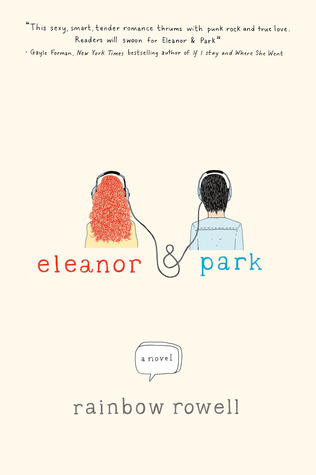
I should say a few things about this book before I try to write through this inarticulate confusion.
- The book is YA Realistic. There's some language, and some PG-13 stuff. It's not too graphic, in my opinion. But it's not MG.
- It takes place in the 80's, with lots of comments about bands, TV shows, and 80's culture - like big hair, bangs, and the walkman.
- It's mostly friendly to teachers. It's not a book about how awesome teachers are. It's also not a book about how evil they are. There are some cool teachers, and some semi-cool teachers, but no horrible, nasty kid-torturers.
All of this adds up to a reasonable claim that maybe the book might be YA that was written for teachers? I'm not sure that's entirely fair. It's a good book, and I think kids would like it. There are several brilliant passages, and I think most kids can feel that when they read it. But it still feels like this book would be really special for older readers, and only pretty good for younger ones. I don't know - I might be wrong about this.
So, what am I trying to say about this book?
I didn't really like the ending. I don't want to spoil it, but it wasn't enough. It didn't feel like the story was really over when it ended.
I should also say that the audiobook was a little disappointing. I enjoyed the audio, but when I wanted to finish the last part of the book, and I finally had access to a paper copy, I found that the printed version of the book was much better than the audio. Rowell's written voice was much richer and fit my imagination much better than the two voices from the audio.
The back-and-forth first-person narration of the book works well when your brain is imagining the voices, I think. I think we can conjure an appropriate-sounding voice for Eleanor, for instance. Then, when Park is narrating what Eleanor is saying, we can use the correct voice, not the Park narrator trying to sound like Eleanor.
Maybe that was the problem. The audio, with two narrators, made the characters feel inconsistent. When the actor reading Park did his voice for Park's father, for instance, it sounded very different from when the actress playing Eleanor tried to do it. (And when Eleanor tried to explain what Park was saying, it sounded fake, and vice versa.)
Perhaps I should re-read this, in print.
So, what did I mean when I said this was "more than a high-school love story"? I think the back-and-forth voices were a cool technique. I think it made the two perspectives more distinct and the narrative richer. I also liked that the characters weren't typical "diamond in the rough" kids - they weren't just popular kids in need of a makeover. Park is half-Korean, and Eleanor is a "big girl."
I also really like Park's parents. They both make terrible, even cruel mistakes with their kids. But then they both end up surprisingly trusting, open, and reasonable. They aren't too good to be true - because both of them have their jerk moments - but both of them more than make up for these things. In some ways, I like Park's father more than Park.
(This feels like a bad rough draft of a review. I'm going to publish this anyway, as a lesson to myself and my students. Hope you enjoyed my unfocused, disorganized, and off-topic meanderings.)
Wednesday, October 30, 2013
I don't know why I love this scene from POLLYANNA so much, but . . . .
I found this clip from the old Disney movie, Pollyanna, on YouTube today, and it surprises me how moving this is for me. Check it out:
It's kind of a cheesy scene, and a little melodramatic. But it's a turning point in the movie, and a turning point for the minister, a major character in the film.
If you aren't familiar, it's about a small town with a powerful, wealthy woman (Pollyanna's Aunt Polly) running a large part of the town's business, including telling the minister what he should preach about. Pollyanna shows up and makes a sad town into a happy town. (It is a Disney movie, of course.)
My parents bought us a VHS copy of this when we were little, and we watched it quite a few times. We didn't have cable, so we watched movies like this a lot. I think I've seen this movie 20 times. (I remember trying to destroy the movie because I hated it so much. I'm glad, now, that I failed.)
So, who cares about an old Disney movie?
I suppose the point of all of this isn't religious conversion. It isn't really a religious message. It's the Abraham Lincoln quote:
I'm not advocating a false sense of positivity. Teachers need to be realistic when they reflect and assess their own teaching. But they also need to be leaders and managers of people. And I think people respond better when you are trying to like them - not trying to find reasons to dislike them.
It's kind of a cheesy scene, and a little melodramatic. But it's a turning point in the movie, and a turning point for the minister, a major character in the film.
If you aren't familiar, it's about a small town with a powerful, wealthy woman (Pollyanna's Aunt Polly) running a large part of the town's business, including telling the minister what he should preach about. Pollyanna shows up and makes a sad town into a happy town. (It is a Disney movie, of course.)
My parents bought us a VHS copy of this when we were little, and we watched it quite a few times. We didn't have cable, so we watched movies like this a lot. I think I've seen this movie 20 times. (I remember trying to destroy the movie because I hated it so much. I'm glad, now, that I failed.)
So, who cares about an old Disney movie?
I suppose the point of all of this isn't religious conversion. It isn't really a religious message. It's the Abraham Lincoln quote:
I think this is a really useful way of cultivating positive relationships with students. It's sometimes easy to see the "bad" in students. I think we can all tell stories about students who struggled in school. It's much more useful, and much more effective, to look for the good. If your goal is to be an effective teacher, noticing and focusing on the "bad" can make you seem negative, pessimistic, and adversarial. Focusing on the positive can help the student like you more, help you like the student more, and help you develop the kind of relationship that can turn into the leverage you need to manage a challenging situation or control a classroom.If you look for the bad in mankind and expect to find it, you surely will.
I'm not advocating a false sense of positivity. Teachers need to be realistic when they reflect and assess their own teaching. But they also need to be leaders and managers of people. And I think people respond better when you are trying to like them - not trying to find reasons to dislike them.
Saturday, October 19, 2013
Engagement and Learning
So, I'm planning to start posting more about my Professional Growth plan here. I'm going to do some research (reading and studying, as well as "action-research") about engagement and its links to learning.
I hope the links are obvious. What I'm after are the specific ways that I can promote engagement for my students - who are, of course, specific people.
The reading list is long and somewhat difficult. I'm planning to include the challenging theoretical research on engagement as well. I'd like to really make this count, and I think a superficial reading based on secondary interpretation of research findings will not suffice. I enjoy the challenge of reading difficult theoretical text. I'm finding more and more that I'm reading "beneath" myself. Which, of course, can be a lot of fun. But I don't want my overdeveloped literacy skills (from years of grad school) to lapse. And I might as well use them for something useful.
So here's an initial list of sources on engagement. For this list, I'm focusing on books. And I'm not going to include full bibliographical information yet. I don't think it's necessary in this context. And, at this point, it's supposed to be a weird list. My goal isn't reading what's "expected" (or only that), but to read as widely as I can.
I hope the links are obvious. What I'm after are the specific ways that I can promote engagement for my students - who are, of course, specific people.
The reading list is long and somewhat difficult. I'm planning to include the challenging theoretical research on engagement as well. I'd like to really make this count, and I think a superficial reading based on secondary interpretation of research findings will not suffice. I enjoy the challenge of reading difficult theoretical text. I'm finding more and more that I'm reading "beneath" myself. Which, of course, can be a lot of fun. But I don't want my overdeveloped literacy skills (from years of grad school) to lapse. And I might as well use them for something useful.
So here's an initial list of sources on engagement. For this list, I'm focusing on books. And I'm not going to include full bibliographical information yet. I don't think it's necessary in this context. And, at this point, it's supposed to be a weird list. My goal isn't reading what's "expected" (or only that), but to read as widely as I can.
- Schlechty, Philip. Engaging Students.
- Bugess, Dave. Teach Like a Pirate.
- Marzano, Robert et al. The Highly Engaged Classroom.
- McGonigal, Jane. Reality is Broken.
- Stager and Martinez. Invent to Learn.
- Zhao, Yong. World-Class Learners.
- Schmoker, Mike. Focus.
- Pink, Daniel. Drive and To Sell is Human.
- Darling-Hammond, Linda et al. Powerful Learning.
- Keene, Ellen Oliver. To Understand.
- Beers and Probst. Notice and Note.
- Lehrer, Jonah. Imagine.
- Wagner, Tony. Creating Innovators.
- Robinson, Ken. The Element.
- Maiers, Angela. Passion-Driven Classroom.
- Ferlazzo, Larry. Self-Driven Learning.
- Hattie, Doug. Visible Learning for Teachers.
- Lemov, Doug. Teach like a Champion.
- Vygotsky, L.S. Mind in Society.
- Loomans. The Laughing Classroom.
- Willis. Research-Based Strategies to Ignite Student learning.
- Stronge. Qualities of Effective Teachers.
- Archer. Explicit Instruction.
- Whitaker. What Great Teachers Do Differently.
- Bomer. Time for Meaning.
- Wilhelm. You Gotta Be the Book.
- Hillocks. Teaching Writing as Reflective Practice.
- Gambrell et al. Best Practices in Literacy Instruction.
- Calkins et al. Pathways to the Common Core.
- Gardner. The Unschooled Mind.
- Himmele and Himmele. Total Participation Techniques.
- Layne. Igniting a Passion for Reading.
- Kittle. Book Love.
- Tovani. So What do they Really Know?
- Dewey. How We Think.
- National Research Council. How People Learn.
- Wilhelm. Engaging Readers and Writers with Inquiry.
- Anderson. 10 things Every Writer Needs to Know.
- Echevarria. Making Content Comprehensible for English Learners.
- Miller. The Book Whisperer.
- Wormeli. Fair Isn't Always Equal and Summarization in Any Subject.
- Wilhelm. Action Strategies for Deepening Comprehension.
- Diller. Practice with Purpose.
- Farr. Teaching as Leadership.
- Copeland. Socratic Circles.
- Erickson. Concept-Based Curriculum.
- Winebrenner. Teaching Gifted Kids in the Regular Classroom.
- Kingore. Differentiation.
- Kagan. Kagan Cooperative Learning.
- Saphier and Gower. The Skillful Teacher.
I won't promise that I'm reading everything on the list. I hope to consult many or most of these, and then some. I'm hoping that I'm researching widely and deeply. And some of these I've already read and already used. But I think going back through my shelves and digging up books that I used to think about more often is a good habit, and will help me try many different things and think critically about their effectiveness.
Saturday, August 31, 2013
Invent to Learn by Gary Stager and Sylvia Martinez - Some Key Points
 |
| The TMI (Think-Make-Improve) Robot |
The book is almost worth purchasing just for the resources it recommends for various maker movement sites, programming education links, and so on. There's a ton.
I should also say that both authors maintain a vigorous web presence, through Twitter (@garystager and @smartinez), their sites (http://blog.genyes.org/ and http://www.stager.org/news.html, and Gary's blog at http://stager.tv/blog/), and lots of Maker sites (like http://makezine.com/) and book-related links (like http://www.inventtolearn.com/). All of these are worth investigating.
Here are some of the big ideas from the book, for me:
- Constructionism (slightly different from constructivism) - learning happens most reliably "when the learner is engaged in a personally meaningful activity outside of their head that makes the learning real and shareable" (32). "The power of making something comes from a question or impulse that the learner has, and is not imposed from the outside. . . " A personal impulse is much stronger and much more meaningful if it comes from the learner and not from a teacher, parent, or friend. "We seek to liberate learners from their dependency on being taught."
- Making, Tinkering, and Engineering - Making is "about the act of creation with new and familiar materials" (33). It's about expressing your intellect through building things, and taking ownership of the products of that experience, something the book calls the "Ikea effect" - when people value their creations, even when they are flawed, over perfect creations built by experts. (This makes me think of Karl Marx and the way that the worker identifies with the product of his/her own labor.) Tinkering is a playful, unstructured approach to authentic problem-solving. "When you tinker, there are no instructions - but there are also no failures, no right or wrong ways of doing things. It's about figuring out how things work and reworking them. Contraptions, machines, wildly mismatched objects working in harmony - this is the stuff of tinkering. Tinkering is, at its most basic, a process that marries play and inquiry" (38). Engineering is "the application of scientific principles to design, build, and invent" (39).
- Spiral Design Model - a model of the design process based on the way that software is typically designed, tested, published, redesigned, tested, re-published, and so on. The goal of a design model like this (instead of a simple create-publish design, or the simplified, heavily-structured model of the writing process) is "to make constant forward progress through a series of gradually improving prototypes" (49). This iterative design process encourages more creative play with materials - because if you build it and it doesn't work, you can still fix it and make it better. In fact, this model is closer to the imaginative play of young children (create, share, adjust, re-share, and so on).
- Less Us, More Them as a "Teaching Mantra" - Let the kids be more in charge in the classroom. "To start making your classroom more student-centered, demonstrate a concept and then ask students to do something" (70). Stager and Martinez mention a study where two groups of children were given a toy. One group was taught how to play with the toy, the other was not. Both groups were able to play with the toy appropriately, but the second group - which was not provided instruction about how to use it - discovered a wider range of uses for the toy than the first group. The moral: kids are more creative when they are given more freedom to discover for themselves.
- Creation is the heart of creativity. They have to make things if they are going to learn to be creative.
 |
| Iterative Spiral Design Model from Boehm, 2000 |
There is a lot of material besides these big ideas - these are just my big takeaways. And I'm sure that I'll notice more as I revisit the book this fall to plan my computer programming lessons (which I'm doing because of this book).
After these sections, Stager and Martinez talk about three big ideas that they call the "game changers": fabrication (as in 3-D printing), physical computing (as in building robots or painted circuits), and computer programming. I don't want to try to talk about all of these things in this post, but I do want to come back and say more about the latter- computer programming. My students will be receiving Chromebooks later this fall, and I hope to teach them how to write programs with them. I haven't decided all of the specifics yet, but I'm committed.
There are a lot of good things in this book, even apart from the resources related to the three "game changers." I definitely think that it's worth looking at.
Here's a great video about Sylvia, an 11-year-old Maker, and her "Super-Awesome Mini Maker Show":
New Posting Schedule
Well, I've been so fired up about the new school year, I haven't been responsible for posting here regularly. So, I plan to post about once a week, or about four times a month. I'd like to post less often than I was in June, but with more carefully crafted content. For a while there, while I was trying to post daily, the quality slipped a little. Sorry about that. I hope for less frequent but more thoughtful posts.
Thanks for reading!
Thanks for reading!
Friday, July 19, 2013
Question Types, and why I don't like QAR
I learned about QAR first through a colleague. Then, I taught a series of lessons using the QAR framework to help students understand question types. It came up in my Reading program a few times, and I read an article and some of Taffy Raphael's book about the subject. So, I don't think I'm "dumb" about QAR. Yet, when teaching it for the first time, I couldn't help but get the four question types mixed up. And if I was doing it, you can believe that my students were doing it. In my frustration, I asked myself, "Do they really need to know the differences among so many different question types? Is this worth the teaching and re-teaching that it takes to clarify all of these differences?"
I think the answer is no.
Briefly, in QAR, there are four question types:
- In the book, "Right there" questions - These are questions that you can point to in the text. They are factual, short-answer questions.
- In the book, "Think and Search" questions - These questions require connecting separate parts of text, making inferences across texts, or otherwise require more "searching" than "Right There" questions.
- In my head, "On My Own" questions - These questions are prior knowledge, what you know before you read questions.
- In my head, "Author and Me" questions - These questions connect what you already know to the author, or to bigger things (?).
I have a hard time explaining this because it doesn't feel logically consistent for me. I don't think the distinction works or makes sense. You are reading the book - you can't make connections without referring to the text and yourself. The whole "Author and Me" question type makes no sense. How do you connect without talking about the text? When I explain this to students, I feel forced to make such incomprehensible statements as, "With Author and Me, you're talking about the text in general, not specifically, like you are in Right There and Think and Search." But what about inferential questions about a character? Is that Think and Search, or Author and Me if you are making broader inferences based on connections to other characters or real people? It doesn't feel like it holds water to me.
I don't like these fuzzy and artificial distinctions, but I like teaching the difference between "right there" and other question types. I want my students to recognize and employ the difference. So, the next step for me was teaching the difference between fact-based and more idea-based or more "out there" question types. I tried teaching students to recognize fact-based questions, just as a general test-taking and comprehension strategy. The problem with that approach was the fuzziness of the "out there," non-factual questions. There are just too many things that fall under that umbrella, some of which are useful, and some of which are not.
Enter the three question types. I don't remember where I found this idea, but I think one of the clearest articulations of it comes from Tompkins. Here's a passage from her book, Language Arts:
Questions can be divided into three levels: literal, inferential, and critical. Literal or "on the page" questions have a single factual answer and can usually be answered with a few words or "yes" or "no." When the questions refer to a story or other book that students are reading, the answers are directly stated in the text. The second level of questions is inferential or "between the lines." To answer these questions, students synthesize information and form interpretations using both their background knowledge and clues in the text. The answers are implicitly stated in the text. The third, most complex level of questioning is critical or "beyond the page." These questions are open-ended. They require students to go beyond the text and think creatively and abstractly about global ideas, issues, and concerns. At this level, students apply information, make connections, evaluate and value the text, and express opinions. (p. 349)
I think these three question levels do everything that distinctions among question types should. There are clear and important differences among all three question types, and understanding the differences is much easier and much more valuable. I want students to be able to answer factual questions, but I also want them to see these as less valuable than either of the other two. And I would like them to be using the third question type to be thinking about how they can use what they read, or how adults use what they read.
This three-level question framework also more easily lends itself to analogy and graphic organizers. I've seen some good tree organizers - factual questions are the roots, inferential questions are the trunk and branches, and critical questions are the leaves.
Let me try some examples with my old standby, Harry Potter:
Literal - What are the names of Harry's parents?
Inferential - Why is Hogwarts the only school of magic in Great Britain?
Critical - What message does the series try to support about discrimination and prejudice?
I think this approach is much more useful and much clearer for students, and I think it also establishes a clear hierarchy of complexity and difficulty. I think we want students to work toward critical questions, and I think teaching them this framework helps them see that as a useful goal.
Subscribe to:
Posts (Atom)